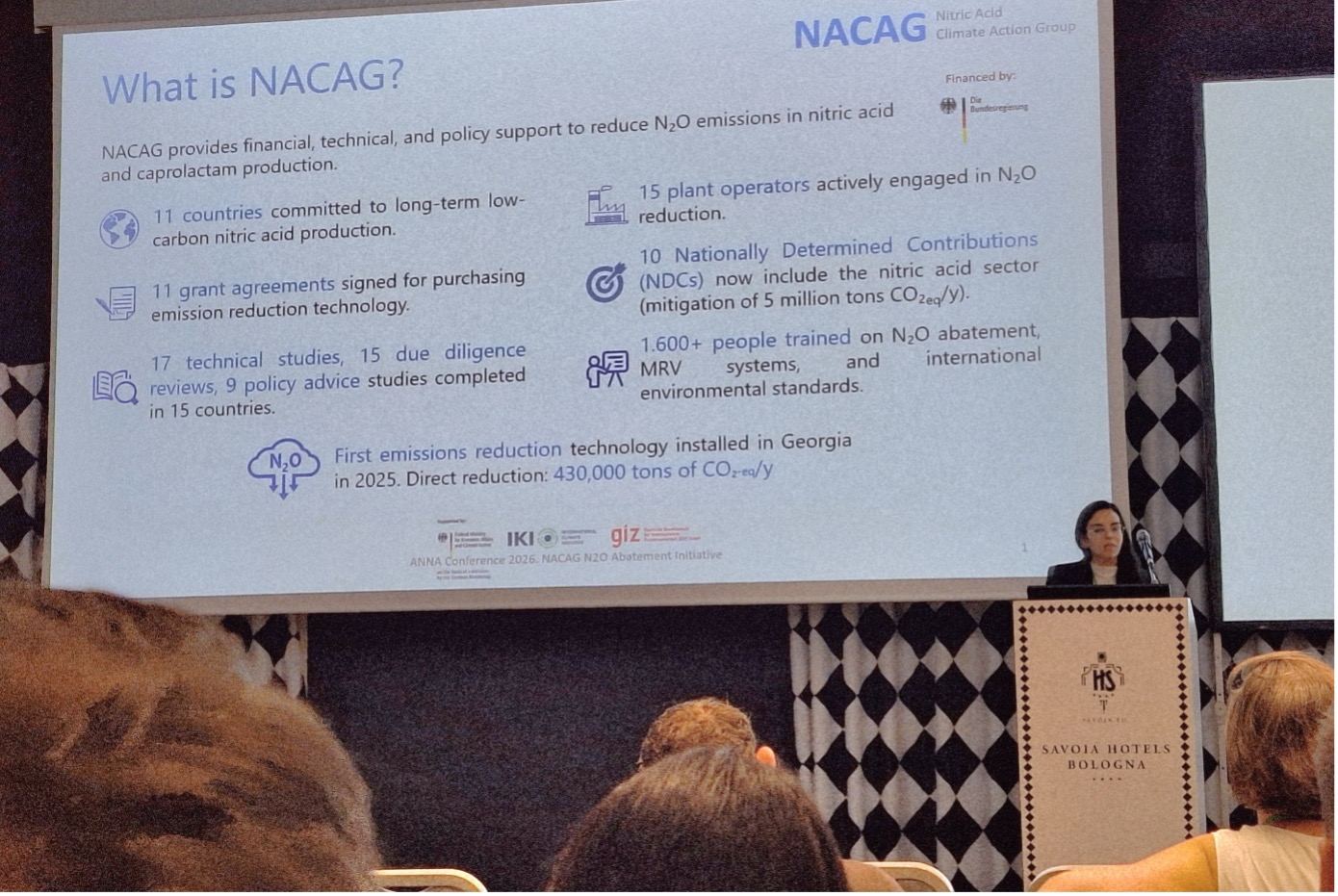
In September 2026, the NACAG Secretariat attended the Ammonium Nitrate and Nitric Acid – ANNA Conference in Bologna. ANNA brings together companies and experts from the ammonium nitrate and nitric acid industry and provides an important platform for knowledge sharing and industry exchange. This year, around 400 participants from across the industry attended the conference.
The discussions focused on current developments and technical solutions in the fields of climate protection and decarbonization. A particular focus was on exchanging ideas with suppliers of N₂O mitigation and monitoring technologies. The discussions provided valuable insights into the latest technological developments.
It became clear that the efficiency and lifetime of N₂O abatement catalysts continue to improve. With modern catalyst technologies, N₂O reductions of more than 99% are possible. Such solutions are particularly relevant in Europe, where the requirements and economic framework of the EU Emissions Trading System (EU ETS) create strong demand for effective N₂O abatement.
NACAG also used the conference for personal discussions with several of its partners and operators of nitric acid plants. The discussions focused in particular on the progress of ongoing projects and the next steps in joint activities. It is planned that over the next six months, four additional plants will be equipped with catalysts funded through NACAG, enabling significant reductions in their N₂O emissions. T
Another important part of the conference was the joint presentation with Endress+Hauser of the lessons learned from the installation of N₂O monitoring technology at one of the plants. Practical experience and insights gained during the installation were shared with conference participants and discussed with other industry representatives. Sharing practical experience is an important part of improving monitoring solutions and facilitating their implementation in existing plants.
The ANNA Conference 2026 once again provided a valuable opportunity to follow the latest industry developments, strengthen existing partnerships and gain new ideas for future projects. At the same time, the conference highlighted that highly developed technologies for effective industrial climate protection are already available today. However, there remains significant potential for further N₂O emission reductions worldwide.
To unlock this potential, suitable regulatory and economic frameworks and incentives are essential. These can include market-based instruments such as emissions trading systems (ETS) as well as clear regulatory requirements for emission reductions. Combining available technologies with appropriate political and economic framework conditions can make an important contribution to realizing the significant potential for N₂O emission reductions worldwide.