Georgia’s nitric acid plant Rustavi Azot avoids around 432,000 tonnes of CO2 equivalent every year, a milestone for industrial climate action in the Caucasus.
JSC Rustavi Azot has officially inaugurated its modernised catalytic abatement reactor at the nitric acid plant in Rustavi on October 19. The modernisation was realised with support from the Nitric Acid Climate Action Group (NACAG) and achieves a total emission reduction of nitrous oxide (N2O) by about 432,000 tonnes of CO2 equivalent per year. That is comparable to the emissions of more than two million people flying from Tbilisi to Berlin – or 45 aircrafts taking this trip daily on 365 days a year.
The modernised reactor now removes 432,000 tonnes CO2 equivalent of the nitrous oxide (N₂O) formed in nitric acid production – this is 95% of N2O emissions. Compared with the plant’s emission level in 2019, this means a net annual reduction of about 120,000 tonnes of CO₂e. When the grant was signed in 2022, NACAG had estimated a reduction of around 90,000 tonnes per year against the plant’s emissions at the time. N2O is a greenhouse gas harmful to the climate and environment alike, it damages the ozone layer and stays in the atmosphere for more than century. Moreover, the filtration of NOx (nitrogen oxides) improves local ambient air quality and therefore is an improvement for the people of Rustavi, too.
A ceremony at the heart of the plant
The event was attended by Davit Songulashvili, Minister of Environmental Protection and Agriculture of Georgia; Nino Latsabidze, Mayor of Rustavi; Anna-Maria Schneider, Head of Development Cooperation for Georgia and Azerbaijan at the German Embassy; as well as representatives of the Government of Georgia, the German Embassy, GIZ, international financial institutions, local authorities and partner organisations.
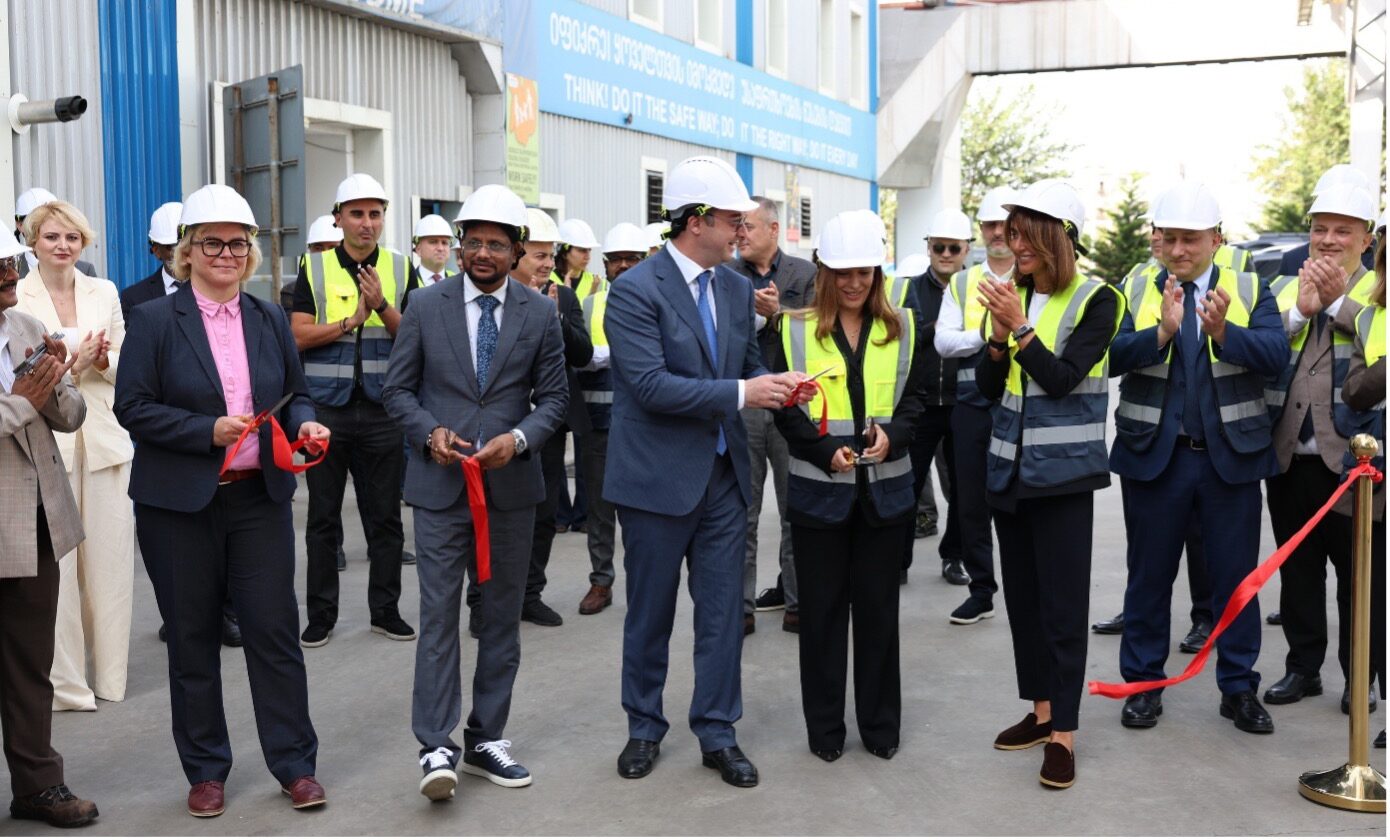
Guests were welcomed at the factory entrance before being transferred to the nitric acid plant. At the centre of the programme was the official ribbon-cutting, carried out by Davit Songulashvili, Minister of Environmental Protection and Agriculture of Georgia; Nino Latsabidze, Mayor of Rustavi; Anna-Maria Schneider, Head of Development Cooperation for Georgia and Azerbaijan at the German Embassy and the General Director of JSC Rustavi Azot, Mr Jay Prakash Jajoo.
Afterwards, participants moved to the conference room for welcome remarks by representatives of Rustavi Azot, the Georgian government, the city of Rustavi, the German Embassy, the Nitric Acid Climate Action Group, and a presentation of the project’s technical and environmental benefits. The event ended with a lunch reception at the Rustavi Azot site.
From political commitment to climate action
The project in Rustavi began with a political decision. In March 2020, Georgia’s Minister of Environmental Protection and Agriculture signed NACAG’s Statement of Undertaking, a commitment to regulatory measures to reduce N2O emissions from nitric acid production. This step made it possible for Rustavi Azot to apply for NACAG support.
In 2022, Rustavi Azot went through NACAG’s due diligence process, which looked at plant operation, data and reporting with international standards. Following two international tenders, the abatement contract was awarded in 2024 to Alvigo, with Clariant as subcontractor, the CEMS (continuous emission monitoring system) award went to SICK. The abatement system was installed in autumn 2025 and is running since.
Additionally, Rustavi Azot decided to finance a NOx catalyst by their own financial means. This technology filters harmful nitrogen oxides from the exhaust stream and therefore improves local air quality in Rustavi.
Technology that is measurable and built to last
The installation combines proven catalyst technology for N2O abatement with a modern emissions monitoring system that measures emissions in real time. This gives the plant continuous insight into its emission flows, which brings transparency as well as benefits for efficiency and operational safety.
Rustavi Azot has invested EUR 3.0 million of its own funds, alongside the German grant of EUR 2.26 million, and has committed to covering the operation and maintenance costs in the long term. This is what makes the climate benefit permanent: a one-time installation becomes a lasting solution.
Policy framework: Georgia delivers on its 2020 commitment
In the March 2020 Statement of Undertaking, Georgia committed to regulation requiring permanent N₂O abatement and monitoring in nitric acid plants. This regulation is now in force: the Law of Georgia on Industrial Emissions, adopted in June 2023, has applied in full since 1 September 2026. Modelled on the EU Industrial Emissions Directive, it allows nitric acid production only under an integrated environmental permit, based on best available techniques, with regular reporting, published monitoring results, inspections and sanctions for non-compliance. Because the law does not exclude greenhouse gases, an N₂O limit can be set directly in Rustavi Azot’s permit, which is due by September 2030 at the latest. With abatement and monitoring equipment already installed and operating, the plant is ahead of the legal schedule. NACAG will accompany the next regulatory steps through its policy dialogue.
Climate benefit at a glance
- About 432,000 tonnes of CO2e avoided every year compared with a plant without abatement
- About 120,000 tonnes of CO₂e per year compared with the plant’s 2019 emission level
- Comparable to more than two million people flying from Tbilisi to Berlin
- Real-time monitoring of emissions
- Long-term operation secured by Rustavi Azot
- Policy Commitment on the Georgian Side
Partnership as the key to success
The project brought together a government willing to commit and set the framework and therefore foundations for this kind of project, a company ready to invest their time and resources, international partners willing and capable to take on such a project and of course
NACAG and GIZ, with the German government, which provided expertise and financial support.